Phyllotaxis forms
Phyllotaxis APIs return generic transforms rather than choosing geometry. The same placement data can drive seeds, petals, fruit, lights, particles, or custom Instances.
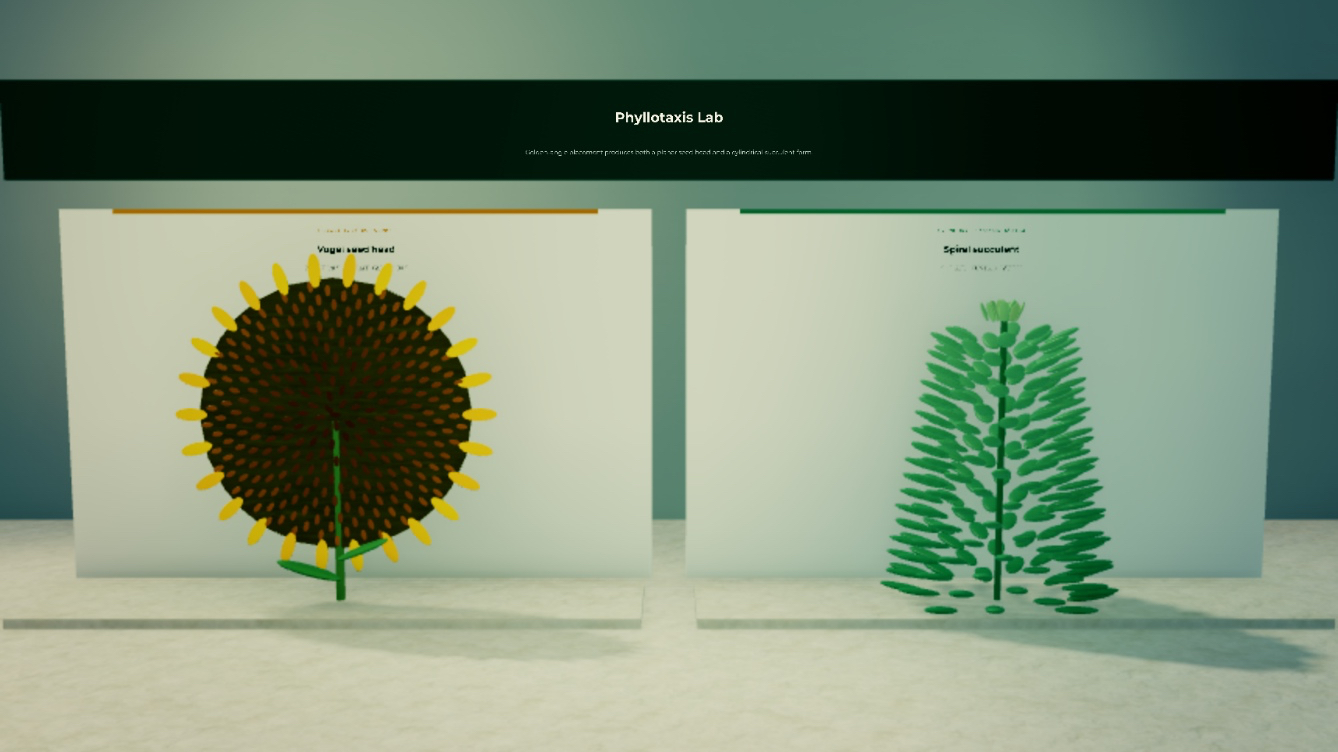
The planar plate contains 280 organs; the cylindrical form contains 190. Both advance by the same golden divergence angle.
import {
GOLDEN_ANGLE,
analyzeParastichies,
placeCylindricalPhyllotaxis,
placePlanarPhyllotaxis,
} from "@rbxts/a-plant-generator";
export const planarHead = placePlanarPhyllotaxis({
count: 280,
divergenceAngle: GOLDEN_ANGLE,
radius: (index) => math.sqrt(index) * 0.42,
organRadius: () => 0.22,
});
export const cylindricalStem = placeCylindricalPhyllotaxis({
count: 190,
divergenceAngle: GOLDEN_ANGLE,
cylinderRadius: (index) => 3.9 - (index / 190) * 1.8,
height: (index) => index * 0.076,
organRadius: () => 0.25,
});
export const likelySpiralFamilies = analyzeParastichies(GOLDEN_ANGLE);
The planar head expands by square-root radius; the cylindrical form tapers as it
rises. likelySpiralFamilies reports low-error parastichy counts for the chosen
divergence angle.
Keep marker geometry lightweight in a Part-based preview. For dense final geometry, batch the transforms in a consumer renderer rather than creating one Instance per placement.